Sector - Finance & Legislation


‘Temporary buildings’ could offer a solution to the UK housing crisis
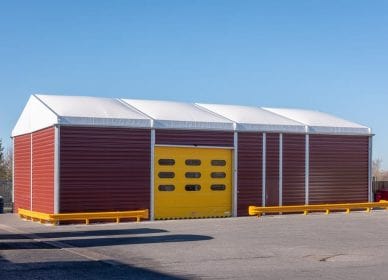
Recent years have seen an increase in the use of modular buildings. Often referred to as ‘temporary buildings’, these structures are prefabricated offsite to a set of measurements and can be disassembled and reused or recycled afterwards. They are widely used at sporting events, in industry and anywhere else where buildings need to be erected quickly and for limited amounts of time. Modular buildings are now so advanced that they often do not even look like temporary structures.
And in fact, they need not be temporary buildings, and often are not. Increasingly, people are turning to modular buildings as a long term solution, including for housing.
In September 2019 the BBC reported that 3.6M people in the UK are living in an overcrowded home, 1.4M are in poor quality homes, and 400,000 are homeless or at risk of homelessness.
As flexible, green and cost effective buildings that are quick to assemble, modular buildings could offer one solution to tackling the UK housing crisis.
The benefits of modular buildings as housing
Traditional brick and mortar houses take years to design, plan, and build. In the meantime, there are still thousands of people waiting for homes. With modular, prefabricated buildings, councils can quickly react to increased demand for housing, offering people safe, clean and warm places to stay, both on a temporary and a longer term basis.
As modular buildings are produced in parts in a factory and assembled on site, how they are used is extremely flexible. Extra units can be added onto existing structures as individual families or whole communities grow. Likewise, if need for housing drops in one area and rises in another, structures can be disassembled and set up elsewhere.
Modular buildings are a lot cheaper to produce, due to the materials used, the efficiency of the process and the reduced amount of labour required. With council budgets always tight and a shortage of cheap housing, affordability is key for both councils and tenants when creating new homes.
Councils are coming under increasing pressure to meet goals for sustainability, and modular buildings could go some way to helping achieve them. Because they are manufactured using CNC machinery, materials are cut very precisely, leading to fewer mistakes and wasted materials. Any offcuts can be recycled in-house too. Offsite construction of building components also means lower emissions as there are fewer vehicles travelling to and from site.
Examples of modular housing solutions
Around the world, people are already starting to turn to modular buildings to create low cost housing.
Nest Living Homes is a concept created by Brooks and Scarpa architects in Los Angeles, a city which has a big problem with homelessness. They describe Nest as a ‘toolkit’ for creating a variety of different housing solutions, rather than one fixed building prototype. It was created as a direct response to Los Angeles’ housing crisis and offers buildings that are made of stackable, prefabricated units that can be configured differently depending on the area and local requirements.
For example, Nest can be used to create homeless shelters, single room occupancy buildings or more traditional apartment buildings, depending on local demand. Whatever in which it is used, the main aim of the project is to provide low-cost shelter and homes, and ultimately dignity, for homeless people.
The Homes for Hope project, which is also based in Los Angeles, is the brainchild of MADWORKSHOP and the USC School of Architecture. Again, this project is made up of modular prefabricated units, and is designed to provide temporary accommodation for around three to six weeks as transition homes for people living on the streets, before they move into permanent accommodation.
The units are made offsite and forklifted onto sites, which are typically small plots of unused land. The units can be stacked or arranged side by side, and each development will include offices for community support services.
Closer to home, it may come as no surprise that one of the leaders in prefabricated housing is the king of flat-pack, IKEA. Together with UK contractor Skanska, they own BoKlok, which builds ‘flat-pack’ modular homes to offer low-cost, environmentally-friendly places to live. With the cost of the building based on an average salary and living costs, they aim to offer comfortable homes with affordable rents and mortgages.
BoKlok have already built 11,000 homes across Scandinavia and have now purchased three initial development sites in the UK, in Worthing, Bristol, and Peacehaven. If planning permission is achieved, these developments will provide 400 new homes.
If projects such as this are successful, there could be a real growth in the number of similar projects offering affordable, modular housing in the UK. Not only would this be good news for people on precarious living conditions, but a rise in this type of modular building would also be a great step towards a more eco-friendly and sustainable way of building and creating homes.
Article submitted by Andy Morley, from the temporary building and warehouse manufacturer HTS Industrial.
If you would like to read more articles like this then please click here.





More Finance & Legislation Features
- Britain’s Builders Are Waiting 53 days to Get Paid, and Eight in Ten Are Eight Months from Collapse
24 Jun 26
Britain's construction sector is heading for a cashflow crisis.
- The Return of CIS NIL Returns and Key Changes for Contractors in 2026
17 Jun 26
Alex Seal from Markel Tax discusses the reintroduction of CIS NIL return requirements from April 202.
- One in five builders say late payments threaten their business
1 May 26
Cashflow pressures remain a major challenge for self-employed construction and building workers, according to new research.